Run and find out
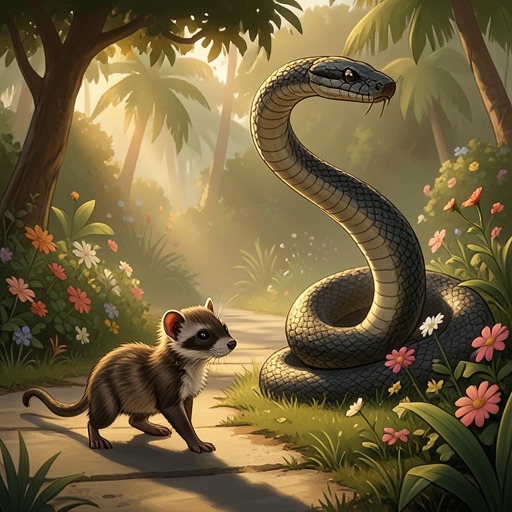
The Jungle Book“Run and find out” is the motto of the mongoose family and the clearest verbal expression of Rikki-tikki-tavi’s nature. It turns curiosity into an active discipline: uncertainty is not endured from a distance but pursued through movement, inspection, and discovery. For Rikki-tikki, the phrase becomes both a personal rule and the engine of his conduct in the bungalow.
Meaning and Animal Character
“It is the hardest thing in the world to frighten a mongoose, because he is eaten up from nose to tail with curiosity.” The expression links courage not to abstract fearlessness but to an overpowering need to know. A mongoose responds to the unknown by running toward it, examining it, and testing what it encounters. Curiosity therefore becomes a survival trait as much as a temperament.
The motto also gives the mongoose a collective identity. It is described as belonging to “all the mongoose family,” while Rikki-tikki is explicitly presented as a true example of it. The phrase thus works like a compact family law: it explains a recognizable pattern of behavior across the species and then measures the individual against that pattern.
Rikki-tikki-tavi’s Introduction
Rikki-tikki-tavi’s first appearance makes the motto concrete. A high summer flood washes him from the burrow where he lived with his parents and carries him, clinging to a wisp of grass, down a roadside ditch. When he recovers on a garden path, he is mistaken for a dead mongoose, but rescue quickly reveals that his defining impulse is still active.
After being warmed in cotton wool, Rikki-tikki examines his surroundings rather than remaining passive. He decides that the cotton wool is not worth eating, runs around the table, sits up to arrange his fur, scratches himself, and jumps onto Teddy’s shoulder. His movement is exploratory and social at once: investigation leads directly to contact and friendship.
The Motto in the Bungalow
The household becomes an expansive field of discovery. After receiving a piece of raw meat and recovering in the sunshine, Rikki-tikki concludes that the house contains more things to find out about than his entire family could discover in their lifetimes. He therefore decides to stay and investigate. The motto is no longer merely a description of instinct; it becomes the reason for his choice of home.
His exploration proceeds through repeated small tests. He nearly drowns in the bathtubs, puts his nose into ink on a writing table, burns it on the end of the big man’s cigar while climbing into his lap to see how writing is done, and watches the lighting of kerosene lamps in Teddy’s nursery. Each incident gives the expression a practical rhythm: run, encounter, examine, suffer a minor consequence, and continue.
At night, the same impulse makes him a vigilant companion. He climbs into Teddy’s bed but remains restless, rising to investigate every sound and determine its cause. Teddy’s father interprets this alertness as protection, arguing that the child is safer with Rikki-tikki than with a bloodhound because the mongoose would respond if a snake entered the nursery. Curiosity thus changes from comic exploration into a form of watchfulness.
Narrative and Thematic Significance
“Run and find out” establishes a discovery-driven pattern within the book’s animal stories. Its wording is brief, imperative, and energetic, unlike the more ceremonial songs, lullabies, and laws associated with other animal communities. It functions as a motto rather than a narrative episode, but it generates action by converting ignorance into a command to move.
The expression also contrasts with fear-based retreat. Rikki-tikki’s curiosity does not mean that every investigation is safe: the flood nearly destroys him, the bath-tubs nearly drown him, and the cigar burns his nose. Yet consequences do not extinguish the impulse. The phrase captures a temperament that learns through direct contact with the world, making discovery the condition of both danger and competence.
In Rikki-tikki-tavi’s story, the motto consequently carries a double significance. It explains his lively, mischievous entrance into human domestic life, and it prepares the reader to understand his later readiness to confront threats rather than ignore them. The mongoose’s defining answer to the unknown is always the same: movement first, knowledge through encounter, and no surrender to fear.